Compliance Docs That Write Themselves
Appfora scans your code and generates Terms of Service, Privacy Policy, Acceptable Use, Payment Terms, Disclosure documents, and Communications policies — tailored to what your product actually does.
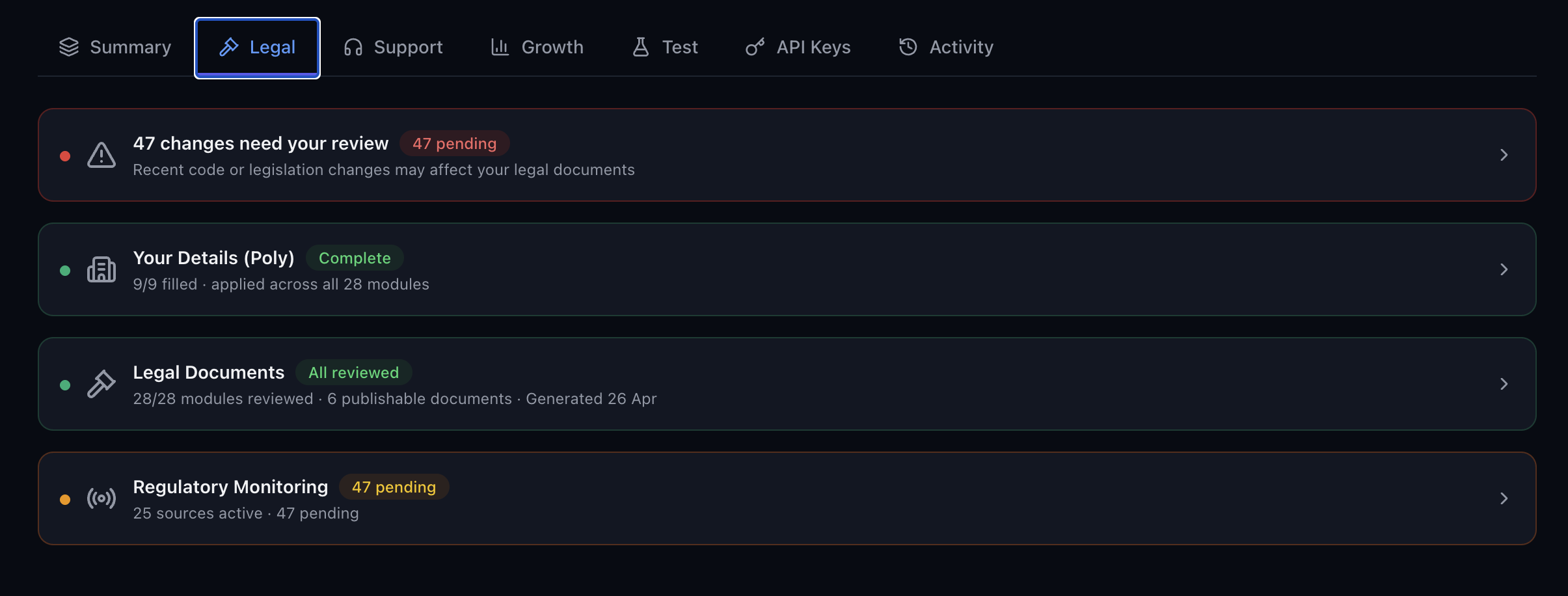
What You Get
Six essential legal documents, each generated from a deep scan of your codebase.
Terms of Service
Define the rules of engagement between your product and its users, covering account creation, acceptable behaviour, and liability.
Privacy Policy
Disclose exactly what data you collect, how you process it, and how users can exercise their rights under GDPR, CCPA, and more.
Acceptable Use Policy
Set clear boundaries on what users can and cannot do with your product, protecting you from abuse and misuse.
Payment Terms
Cover billing cycles, refund policies, and subscription management tailored to your actual payment integration.
Disclosure Policy
Transparently explain how your product works, what data feeds models, and how decisions are made — meeting emerging regulations.
Communications Policy
Define how you contact users — email, push, SMS — and give them clear opt-in and opt-out mechanisms.
How It Works
Scan
We fingerprint your codebase to understand data flows, third-party integrations, and user-facing features.
Generate
A drafting model produces product-specific documents from confirmed evidence, conservative assumptions, and clearly identified unknowns.
Review and publish
An independent model and deterministic checks challenge the draft. You edit, accept, and publish the version you approve.
Key Features
Built to keep your legal docs accurate today and tomorrow.
Regulatory review prompts
Use a new generation when relevant laws or the jurisdictions you serve change, then review the resulting draft before publishing.
Re-scan when code changes
A fresh scan detects changed data flows, features, and integrations and supplies updated evidence for a new reviewed draft.
CI/CD integration
Legal docs as part of your deployment pipeline. Catch compliance gaps before they ship.
Full version history
Every change tracked. Compare versions side-by-side and maintain a complete audit trail.
Evidence and uncertainty controls
Claims are linked to confirmed evidence or marked assumptions, while missing commercial and legal facts remain explicit for human review.
Regulatory monitoring
Global baseline coverage plus jurisdiction-specific rules for GDPR, CCPA, and more.
$8.99/mo
All detected legal documents
- Terms of Service
- Privacy Policy
- Acceptable Use Policy
- Payment Terms
- Disclosure Policy
- Communications Policy
- Evidence-reviewed draft generation
- Re-scan and review when your product changes
- Full version history
- CI/CD integration
Frequently Asked Questions
Appfora generates six core documents: Terms of Service, Privacy Policy, Acceptable Use Policy, Payment Terms, Disclosure Policy, and Communications Policy. Each document is tailored to what your product actually does based on a deep scan of your codebase.
Appfora scans your codebase to identify data flows, third-party integrations, payment processors, technology usage, communication channels, and user-facing features. This fingerprint drives every clause in your generated documents — nothing is generic.
Appfora produces a structured draft, not legal advice or a guarantee of compliance. The draft is checked for evidence, internal consistency, unsupported claims, and completeness, but an authorised human must review and accept it before publication. Obtain qualified legal advice where the risk or jurisdiction warrants it.
Appfora does not silently rewrite published documents. Re-run the Legal generation when a relevant law, jurisdiction, supplier, pricing term, or product behaviour changes, then review and publish the new version deliberately.
Yes. Appfora generates a complete first draft grounded in your codebase, but you retain full control to edit, adjust tone, add clauses, or override any section before publishing.
No. Appfora analyses your codebase to extract a structural fingerprint — data flows, integrations, and feature signatures — but never stores your raw source code. The fingerprint is used solely for document generation.
Complete Your Launch Readiness
Legal is just one pillar. Pair it with intelligent support, data-driven customer growth strategies, and end-to-end test validation.